When More Sun Means Less Power: The Temperature Penalty Hidden Inside Your Solar System
There is a reasonable assumption embedded in most homeowners' expectations about solar energy: more sunshine equals more electricity. July skies are bright, days are long, and the sun climbs high overhead. Surely that must mean peak production. In practice, however, the relationship between summer conditions and solar output is far more nuanced — and for many households across the American South, Southwest, and even the Midwest, mid-summer can represent a period of measurable underperformance relative to milder spring or fall months.
This phenomenon is not a defect in your system. It is a predictable consequence of fundamental physics. Understanding it allows you to plan more intelligently, communicate more clearly with your installer, and take practical steps to recover lost production.
The Physics Behind the Paradox
Solar panels generate electricity through the photovoltaic effect: photons from sunlight knock electrons loose within semiconductor material, creating an electrical current. What many homeowners do not realize is that this process is sensitive not only to the quantity of light available, but also to the temperature of the semiconductor itself.
As panel temperature rises above a standard test condition of 77°F (25°C), the voltage produced by each cell begins to drop. Current increases only marginally in response to heat, so the net result is a reduction in total power output. Manufacturers quantify this relationship using a specification called the temperature coefficient of power, typically expressed as a percentage loss per degree Celsius above 25°C.
For most conventional monocrystalline panels — the dominant technology in residential installations across the United States — this coefficient falls somewhere between -0.3% and -0.5% per degree Celsius. That may sound negligible, but consider a realistic summer scenario in Phoenix, Dallas, or Atlanta: a rooftop panel exposed to direct afternoon sun can reach surface temperatures of 140°F to 160°F (60°C to 71°C), even when ambient air temperatures are in the mid-90s. At 65°C, a panel with a -0.4% coefficient is already operating at roughly 84% of its rated capacity — a 16% reduction that compounds across every hour of peak heat.
Why Installers Rarely Emphasize This
Production estimates presented during the sales process are typically generated using modeling software that accounts for temperature effects at some level. However, those projections are often communicated to homeowners as annual totals, which can obscure month-by-month variation. When a homeowner notices that their July production appears lower than expected given the season, they may assume a malfunction rather than recognizing a predictable thermal pattern.
This is not necessarily an act of omission by installers — it is partly a limitation of how solar data is typically presented to consumers. Reviewing your proposal's monthly production breakdown, rather than focusing solely on the annual figure, gives you a more accurate picture of what to expect throughout the year.
Real-World Impact Across U.S. Climate Zones
The severity of thermal losses varies considerably by geography. Homeowners in coastal California or the Pacific Northwest, where summer temperatures remain relatively moderate, will experience far less thermal penalty than those in the Desert Southwest or the humid South. A system installed in San Diego may lose 8% to 10% of its potential peak-summer output to heat. The same system design installed in Las Vegas or Houston could see losses exceeding 15% to 20% during the hottest weeks.
Interestingly, some of the highest annual solar production figures in the U.S. come from regions with moderate temperatures and high solar irradiance — not necessarily the hottest climates. Colorado's Front Range, for instance, benefits from abundant sunshine, high altitude, and cooler average temperatures that keep thermal losses in check.
Strategies to Reduce Thermal Losses
While you cannot eliminate the temperature coefficient, several design and maintenance choices can meaningfully reduce its impact.
Prioritize Panels with Lower Temperature Coefficients
Not all panels are created equal in this regard. Premium monocrystalline panels from manufacturers who invest in cell architecture often achieve coefficients closer to -0.26% or -0.30% per degree Celsius. When comparing panel specifications during the selection process, ask your installer to highlight this figure alongside efficiency ratings and warranty terms. In hot climates especially, a lower temperature coefficient can translate to thousands of additional kilowatt-hours over the life of the system.
Ensure Adequate Roof Clearance and Airflow
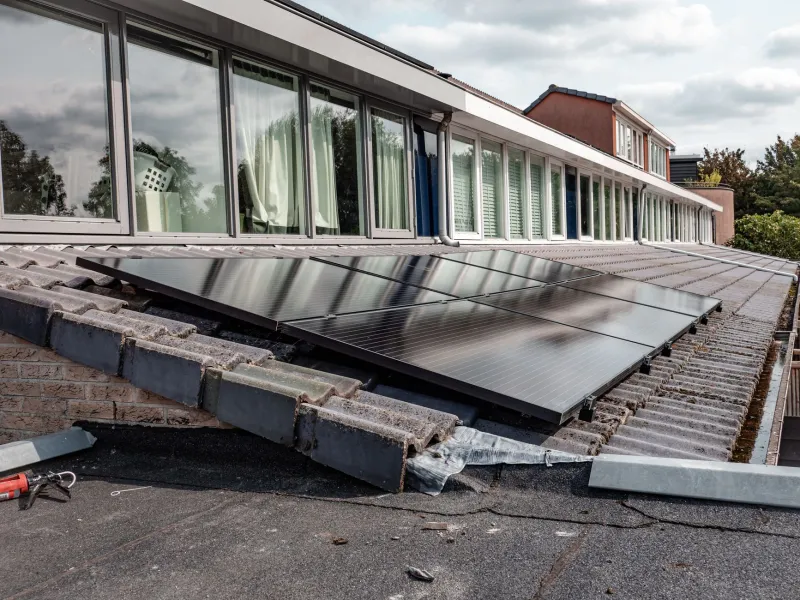
Panels mounted directly flush against a roof surface trap heat beneath them, driving cell temperatures even higher. Standard racking systems typically elevate panels three to four inches above the roof, but in high-heat environments, specifying a greater standoff distance — or choosing racking systems designed to promote airflow — can reduce operating temperatures by 5°C to 10°C. Over a full summer season, that reduction is meaningful.
Consider Panel Orientation and Tilt Adjustments
In some cases, slight modifications to tilt angle can reduce the amount of time panels spend at maximum thermal exposure during the hottest midday hours. This is a nuanced tradeoff, since changing tilt also affects the angle of incidence for incoming sunlight. A qualified solar professional can model different configurations using site-specific data to identify whether any adjustment offers a net benefit for your location.
Monitor System Performance with Granular Data
Modern inverters and monitoring platforms provide hour-by-hour production data that makes it possible to identify whether your system's summer performance aligns with modeled expectations. If production during cooler morning hours is strong but drops sharply during peak afternoon heat, that pattern is consistent with thermal losses rather than equipment failure. Conversely, if underperformance is consistent across all hours regardless of temperature, further investigation may be warranted.
Evaluate the Timing of High-Consumption Activities
For households with time-of-use electricity rates, shifting energy-intensive tasks — running dishwashers, doing laundry, charging electric vehicles — to morning hours when panels are producing efficiently and temperatures remain lower can meaningfully reduce grid dependence even when afternoon output is suppressed by heat.
Setting Realistic Expectations Without Discouraging Investment
None of this is meant to suggest that solar underperforms in hot climates. Quite the opposite: even with thermal losses factored in, solar installations in Sun Belt states deliver exceptional long-term returns, and the high number of annual sun hours more than compensates for the efficiency penalty imposed by heat. The goal is simply to replace an oversimplified mental model — more sun always equals more power — with a more accurate one.
Homeowners who understand the temperature coefficient effect are better positioned to evaluate proposals honestly, choose equipment thoughtfully, and interpret their monitoring data correctly. They are also less likely to initiate unnecessary service calls based on a misunderstanding of normal seasonal variation.
At Team Solar Works, we believe that informed clients make better long-term partners. When you understand your system's behavior across all seasons, you can manage it more confidently — and that confidence is part of what a quality solar investment is designed to provide.