What a Decade of Installations Taught Us About the Myths That Cost Homeowners Real Money
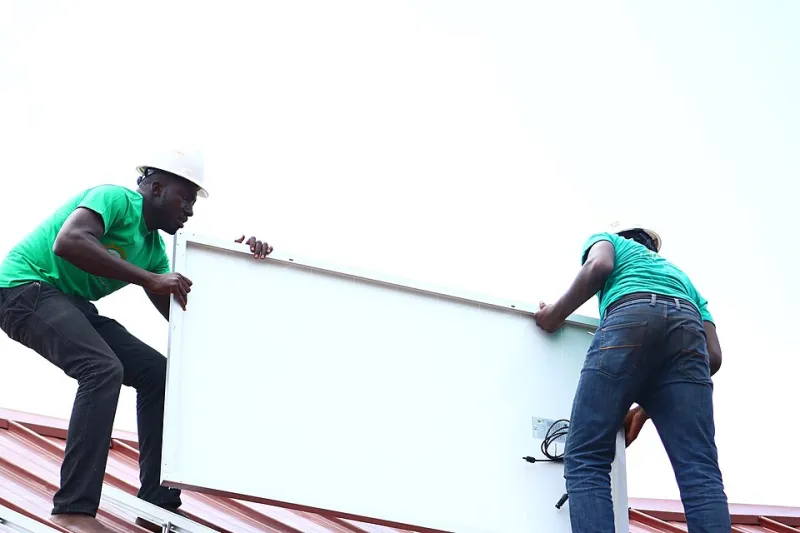
Photo: SAgbley, CC BY-SA 4.0, via Wikimedia Commons
Myth #1: "Solar Doesn't Work in Cold or Cloudy Climates"
This one refuses to die, despite the physics pointing the other direction. Solar photovoltaic panels convert light, not heat — and they actually operate more efficiently in cold temperatures. A crisp 30-degree January day with clear skies can outproduce a sweltering 95-degree July afternoon on a per-hour basis, because panel output degrades as cell temperatures climb.
Germany, hardly a sun-drenched country, built one of the world's largest solar fleets at latitudes matching Alaska's. Cloudy regions simply require slightly larger arrays to hit the same annual production.
The cost of believing it: Homeowners in the Northeast, Midwest, and Pacific Northwest who rule out solar on climate grounds routinely forgo systems with solid 8–12 year payback periods — often in states with above-average electricity rates, where solar savings are actually amplified.
Myth #2: "Panels Will Destroy My Roof"
A properly installed solar array does not compromise a sound roof; it protects it. Mounted panels shield the underlying shingles from UV degradation, hail, and rain. The flashing and mounting hardware used in modern installations penetrates the roof in engineered locations, sealed to standards that routinely outlast the shingles themselves.
Roof problems arise from two avoidable sources: installing on a roof already near the end of its life, and hiring contractors who cut corners on flashing. Both are solvable with due diligence, not reasons to abandon solar.
The cost of believing it: Waiting five years for a roof replacement that could have been coordinated with installation — losing five years of savings that often exceed $8,000–$15,000, while forfeiting years of federal tax credit eligibility at current values.
Myth #3: "I Should Wait for Better Technology"
This is the most seductive myth, because it sounds like prudence. Yes, panel efficiency improves each year. But the financial math does not reward waiting.
Panels installed today carry 25-year warranties and degrade at roughly 0.5% annually — meaning a system will still produce near 87% of its original output in year 25. The efficiency gains between now and five years from now are incremental, not transformative. Meanwhile, every waiting year is a year of full-price utility bills, and incentive programs (like the residential tax credit) are subject to political revision, not guaranteed to be more generous later.
The cost of believing it: A household spending $250 per month on electricity burns $3,000 annually while waiting. Over five years, that is $15,000 in avoided savings — typically more than the entire improvement in technology over that span.
Myth #4: "Solar Means Going Off the Grid"
A stubborn fraction of homeowners dismiss solar because they want no dependence on utilities at all — and assume grid-tied systems are a half-measure. In reality, the overwhelming majority of cost-effective solar installations remain grid-connected deliberately. The grid serves as infinitely large, free storage; excess summer production banks credits that offset winter consumption.
True off-grid independence requires battery banks sized for the worst week of the year, backup generation, and a cost premium that can double or triple the project. For most households, grid-tied solar with optional battery backup delivers 90% of the benefit at 50% of the cost.
The cost of believing it: Either foregoing solar entirely, or over-building an off-grid system tens of thousands of dollars beyond what the household's actual needs require.
Myth #5: "Maintenance Will Eat the Savings"
Solar systems have no moving parts. There is nothing to lubricate, replace seasonally, or tune. Rainfall handles the vast majority of panel cleaning in most climates, inverters carry 10–25 year warranties depending on type, and monitoring software flags underperformance remotely.
Realistic lifetime maintenance on a residential system amounts to a possible inverter replacement mid-life — typically $1,500–$3,000 — spread across decades of production.
The cost of believing it: Homeowners who buy into maintenance fears sometimes purchase inflated third-party service contracts they do not need, or again, delay installation while imaginary costs accumulate against real utility bills.
The Pattern Behind All Five
Notice what these myths share: each one sounds like caution, and each one functions as a delay. The financial consequence of solar misconceptions is rarely an outright loss — it is the quiet accumulation of utility payments made while a viable system sat uninstalled. In our experience, the most expensive solar decision is not a bad installation. It is the good one that never happened.